
Terrazzo vs tiles: which floor is better?
Updated 2 November 2026
When you plan a new floor in Tanzania, the choice often comes down to two options: tiles or terrazzo. Both look good on the first day. The difference shows after years of daily use. Here is an honest comparison to help you choose.
How they are made
Tiles are made in a factory and laid one by one, with grout between them. Terrazzo is made on site: marble chips are mixed with cement, laid as one surface, and then ground and polished until the floor is smooth and shiny.
Joints and cleaning
A tiled floor has a grout line around every tile. Grout collects dirt and gets dark, and tiles can crack or come loose, often at the edges. A terrazzo floor is one surface with only a few thin divider strips, so there are almost no joints where dirt can sit. A daily sweep and mop keeps it clean.
Design and colour
With tiles you choose from what the shop has in stock. With terrazzo you choose the chip colours (white, pink, black), the cement (grey or white) and the pattern: plain, star, diamond, stripes, stairs, or a custom star or logo. Steps and stairs can be made in the same material, so the whole building matches.
When it wears: polish instead of replace
Tiles that are scratched, stained or broken have to be taken out and replaced, and a matching tile is often no longer on sale. A worn terrazzo floor can be ground and polished again on site, and the shine comes back. We polish existing terrazzo floors for TZS 5,000 – 15,000 per m².
Where terrazzo makes sense
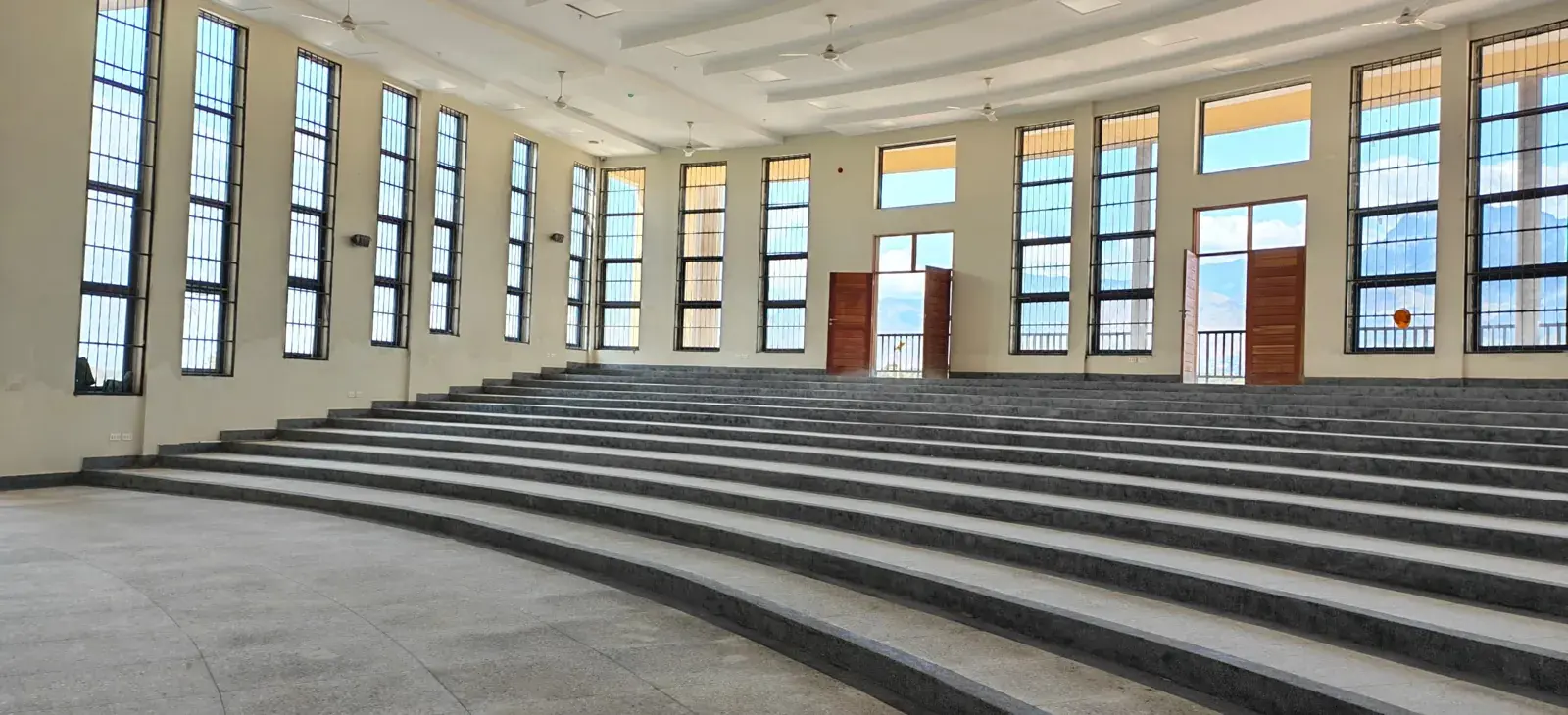
Terrazzo is made for places where many people walk every day: schools and universities, hotels, offices, corridors, halls and stairs. In a building like that, a floor you can renew by polishing is worth more than a floor that only looks good at the start.
The honest downsides of terrazzo
Terrazzo is not the right choice for every project. Before you decide, know this:
- Higher starting price. Our terrazzo floors cost from TZS 45,000 per m² with labour and materials. Tiles are usually cheaper at the start.
- It needs skilled craftsmen. Terrazzo is made on site, so the result depends on the team. Look at real projects and order a sample first.
- It takes time. About 100 m² takes 7–10 days, because the floor is laid, left to harden, then ground and polished.
- Minimum size. We make terrazzo floors from 100 m².
Terrazzo in real buildings
Universities chose terrazzo for busy lecture halls, corridors, stairs and labs. These are our university projects from 2026:
- Mzumbe University
Floors and steps · 4,600 m² · Morogoro
- DIT
Dar es Salaam Institute of Technology
Floors · 3,400 m² · Dar es Salaam
- DUCE
Dar es Salaam University College of Education
Countertops · 3,900 m² · Dar es Salaam
So which is better?
For a small room on a tight budget, tiles can be the simpler choice. For a large building with heavy foot traffic, or when you want a floor that can be renewed by polishing instead of replaced, terrazzo is worth its higher starting price. See what it costs in our price guide, or ask us on WhatsApp.
Get a price for your floor
Make an estimate in the price calculator, or send us your area and location on WhatsApp.
Questions & answers
Is terrazzo better than tiles?
It depends on the building. Terrazzo has almost no joints, can be made in your chip colours and pattern, and can be polished again instead of replaced. Tiles usually cost less at the start.
Is terrazzo more expensive than tiles?
At the start, usually yes. Our terrazzo floors cost from TZS 45,000 per m², labour and materials included.
Can an old terrazzo floor be restored?
Yes. It can be ground and polished again; we charge TZS 5,000 – 15,000 per m².
How long does it take to make a terrazzo floor?
About 100 m² in 7–10 days.